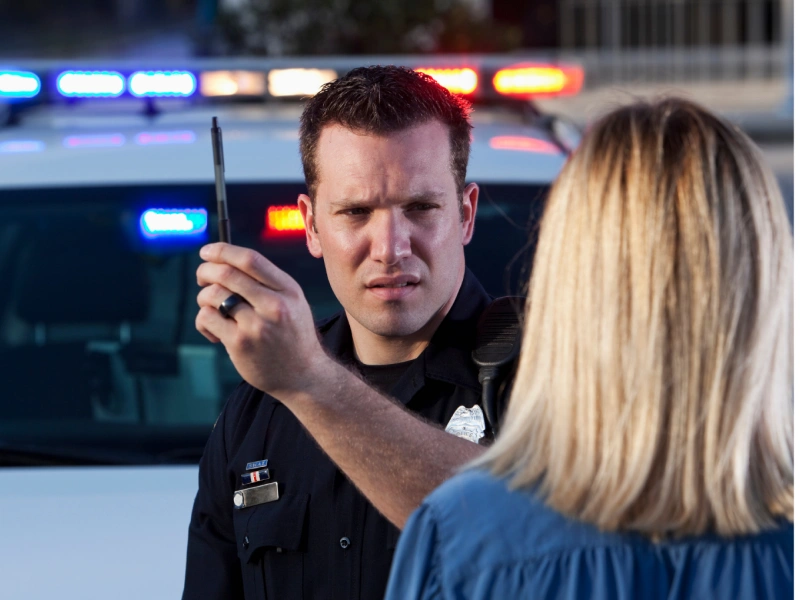
What Are Field Sobriety Tests—and Are They Really Accurate?
Field sobriety tests are a series of roadside exercises used by law enforcement to evaluate whether a driver may be impaired. The most commonly used tests fall under what are known as Standardized Field Sobriety Tests (SFSTs), which were developed by the National Highway Traffic Safety Administration (NHTSA).
The three standardized tests include:
- Horizontal Gaze Nystagmus (HGN) – tracking eye movement
- Walk-and-Turn Test – walking heel-to-toe along a straight line
- One-Leg Stand Test – balancing on one foot for a set period
While these tests are often presented as reliable indicators of impairment, even NHTSA acknowledges that they are not foolproof. In fact, their accuracy depends heavily on strict adherence to standardized procedures—procedures that are frequently not followed in real-world traffic stops.
The Subjectivity Problem with SFSTs
One of the biggest misconceptions about field sobriety test accuracy is that they provide objective, measurable results. In reality, SFSTs rely heavily on an officer’s interpretation, which can be influenced by numerous external and internal factors.
Officers are trained to look for “clues” of impairment, but those clues can appear for reasons entirely unrelated to alcohol or drug use. Nervousness, fatigue, medical conditions, or even unfamiliarity with the test instructions can all lead to what appears to be a “failure.”
As part of fighting a DUI charge, a seasoned defense attorney will carefully examine whether the tests were administered exactly as required—or whether subjective judgment filled in the gaps.
Environmental Factors That Lead to False Failures
Field sobriety tests are ideally conducted under controlled conditions. Unfortunately, roadside stops are anything but controlled. When challenging DUI evidence, a “bulldog” lawyer focuses on environmental and situational factors that compromise test validity, including:
- Uneven or sloped pavement
- Poor lighting or glare from headlights
- Weather conditions such as rain, ice, or wind
- Traffic noise and distractions
- Inappropriate footwear or clothing
These conditions make balance and coordination difficult for anyone, sober or not. Yet drivers are often judged harshly for struggling under circumstances that would challenge even an athlete.
Cross-Examining the Officer: Where DUI Cases Are Won
A strong DUI defense attorney does not accept field sobriety test results at face value. Instead, the defense scrutinizes how the tests were conducted and whether the officer followed proper SFST guidelines.
Key questions often include:
- Was the officer properly trained and certified?
- Were the instructions given clearly and consistently?
- Did the officer deviate from standardized procedures?
- Were alternative explanations for “clues” considered?
By methodically breaking down these details, defense counsel can demonstrate that the prosecution’s evidence is less reliable than it appears. In many cases, this creates reasonable doubt—an essential component of a strong DUI defense under Pennsylvania law.
A Failed Field Sobriety Test Is Not a Conviction
It is critical for drivers to understand that field sobriety tests are not pass/fail exams, nor are they definitive proof of impairment. They are merely one piece of evidence—and often one of the weakest—used in DUI prosecutions.
Pennsylvania courts recognize that DUI cases must be evaluated based on the totality of the circumstances. That means every detail matters, from the initial traffic stop to how evidence was collected and presented.
Don’t Let a Subjective Roadside Test Dictate Your Future
A DUI charge can have serious consequences, but it is not the end of the road. Field sobriety tests are frequently flawed, improperly administered, and open to legal challenge. That’s why it’s essential to have an attorney who knows how to tear apart unreliable DUI evidence and hold the prosecution to its burden of proof.
Don’t let a subjective roadside test dictate your future. If you’ve been charged with a DUI, you need a bulldog in your corner to tear apart the prosecution’s evidence.
